Thoughts along the way...

Tag: politics

Five years seems like a century ago

January 6th was a disgrace. American citizens attacked their own government. They use terrorism to try to stop a specific piece of domestic business they did not like. Fellow Americans beat and bloodied our own police. They stormed the center floor. They tried to hunt down the Speaker of the House. They built a gallows and chatted about murdering the vice president. They did this because they’d been fed wild, falsehoods by the most powerful man on earth because he was angry. He lost an election. Former President Trump’s actions preceded the riot or a disgraceful dereliction of duty…

There’s no question, none, that President Trump is practically and morally responsible for provoking the events of the day. No question about it.

Sen. Mitch McConnell, R- Kentucky (as Minority Leader), February 13, 2021

History lessons

Kids today have it so much better than when I was in school. Back then, we had to read about historical events like “gunboat diplomacy” in dusty old textbooks.

Today, history classes can just watch the news…

Ahead: A Year of History

2026 Is going to be a year of history, if not an historic year in its own right, if this morning’s news about our military action in Venezuela is any kind of harbinger of things to come. This past year was a whirlwind of, well, shit, as the “Flood The Zone With Shit” playbook1 was opened to every chapter. 

What has concerned me all along me is the zone flooding was only the beginning, as norms were tested to the breaking point again and again and again. As we head into this year, I call it a year of history not because of today’s headlines, but because 2026 marks the Semiquincentennial of the event we mark as the birth of our nation. In July, we will celebrate 250 years since fifty six men from 13 colonies declared the independence of those colonies from their sovereign across the pond.2

It would be a dozen years before we arrived at the form of governance we are still – theoretically – working under. The actual date of our nation’s birth can arguably be pegged to a few major events, but the events of early July in 1776 are a good place to find consensus on our origin story.

Folks in the commonwealth of Massachusetts would like you to think that they started it all about fifteen months earlier, with the famous shots fired on the Lexington Common and the bridge in Concord in April of 1775, celebrated annually as Patriot’s Day, a state holiday in Massachusetts and Maine (the latter being part of the former when the events occurred…).

We all heard about Paul Revere’s famous ride…but growing up, the version we heard in seacoast NH was the ride that happened five months before the ride memorialized by Henry Wadsworth Longfellow’s epic poem (recitals of which, curiously, were also part of growing up back in the day). On December 14, 1774, Revere rode north to Portsmouth, NH, to warn the militia there that the British were sending troops to reinforce Fort William and Mary, which commanded the Piscataqua River entrance to the Portsmouth Harbor. Men from Rye, Dover, Durham, and Madbury raided the fort and stole its stores.3 Shots were fired – the first time colonial militia fired on British regulars – but it was a small group of troops in the fort, quickly overcome by the mob. Admittedly it was a far cry from what went down the following April – but it was still first.

Of course, the notion of violence in the face of the British rules for the colonies was expressed a year prior, on December 16, 1773, when the famous Boston Tea Party began a long tradition of polluting Boston’s Harbor (it was followed a few days later by the Philadelphia Tea Party, which few outside of Philly or history buffs are even aware was a thing). This wasn’t the taking up of arms agains British Troops, but it acted like a canon shot across the bow.

The point in all of this is to say that we the people are going to have myriad opportunities to re-learn (or in some cases learn) the story of our nation with a big-number birthday as a backdrop. Ken Burns is helping out with his take on the American Revolutionary War; over the course of the year we can expect to see a number of television programs, magazine spreads, analysis, commentary, and assorted coverage in the many media out there.

The problem with this is the background against which we have to celebrate this anniversary: a government led by a man and cabal more interested in rewriting history, calling truth “fake news,” and self-serving for their own tainted glory and legacy. I shan’t recount the unilateral actions taken by this administration that fly in the face of the law, the norms, or the history of our governance, but I will point out one of the more visible affronts, wherein the president gutted the board at the Kennedy Center, which last month, in turn, voted to rename the center with the president’s name.

From nytimes.com:

[The presdident] said on Thursday that he was “surprised” and “honored” that the center’s board, of which he is the chairman, had thought to do this for him, almost as if it were coming out of the blue. And yet he has been referring to the center as “[president’s name]-Kennedy” in social media posts for months — and the new lettering for the building’s face was all ready to go the next morning.

It is only a distraction, of course. It takes an act of Congress (even a supine one) to make that change, as it took an act of congress to create the center in the first place, as the nation’s memorial to the slain Kennedy. The president could just as easily fake a name change to the Lincoln or Jefferson Memorials or the Washington Monument – and, honestly, I would not put it past him to do so – but that would not change the reason those memorials were erected.

We have seen, in his first administration and now the second one, an inclination to rewrite history with the levers available in the Oval Office.4 Narratives are being changed in museums, for example, to make the Civil War seem less about slavery and more about “state’s rights.”

By the time we get to July, what will the story as portrayed on our federal stages of our nation’s origin look like?

This is not an original thought or concern. Nor is it new – nine years ago I wrote a piece arguing that we cannot allow ourselves to normalize what we see as if it is somehow normal.

This year will be a year of history. Merriam-Webster defines history as, “a chronological record of significant events (such as those affecting a nation or institution) often including an explanation of their causes.” We have a record of events that won’t change. Names, dates, times, places of things that happened to make ours an independent nation are all well -documented and won’t change.

What will change, and has been for some time now, is the power with which those who wish to change the explanation of things can amplify their skewed version of who we are as a nation, and twist that perception to their vile ends.

You know – flooding the zone with their shit.

Then again, this is a year of history, being written down today for the story of how we met this challenge as it will be told years from now. What will they be saying at the Semiquincentennial of our Constitution a dozen years from now?

Assuming we make it that far…

  1. https://www.cnn.com/2021/11/16/media/steve-bannon-reliable-sources ↩︎
  2. https://www.archives.gov/founding-docs/declaration-transcript ↩︎
  3. https://nhmuseumtrail.org/raid-on-fort-william-and-mary/ ↩︎
  4. https://www.cnn.com/2025/09/17/us/museum-censorship-smithsonian-risks ↩︎

271 Words

Eight score and a pair of years ago today, in the midst of a bloody civil war, our nation dedicated a national cemetery on the grounds where the Battle of Gettysburg took place a few months earlier. It was a cool autumn day, and in attendance was the President of the United States, Abraham Lincoln. 

But Lincoln was not the main orator for the event; that honor was accorded to Edward Everett, who prepared a 13,607 word address that lasted two hours. When he was done, Lincoln rose to make some concluding remarks. 

He spoke for about two minutes; he used only 271 words. Everett afterward said, “I should be glad, if I could flatter myself that I came as near to the central idea of the occasion, in two hours, as you did in two minutes.”

As much as he was honoring the dead of Gettysburg, Lincoln was speaking to the future of our nation. Once again, we find ourselves engaged in a great civil war of sorts, testing whether this nation, conceived and dedicated to the proposition that all men are created equal, can long endure. Lincoln said:

The world will little note, nor long remember what we say here, but it can never forget what they did here. It is for us the living, rather, to be dedicated here to the unfinished work which they who fought here have thus far so nobly advanced. It is rather for us to be here dedicated to the great task remaining before us—that from these honored dead we take increased devotion to that cause for which they gave the last full measure of devotion—that we here highly resolve that these dead shall not have died in vain—that this nation, under God, shall have a new birth of freedom—and that government of the people, by the people, for the people, shall not perish from the earth.

We find ourselves at a strange juncture; our Union is at arguably the greatest risk it’s seen since Lincoln’s time. We’re not fighting in open fields with canon, cavalry, muskets and bayonets, which makes these far more insidious circumstances. Without the physical carnage of bloody bodies, it is not as easy to see the attacks made upon our rule of law by the folks in control, who, in terrible irony, refer to their caucus as the party of Lincoln.

It is for us to honor all who gave the last full measure of devotion that this nation shall have a new birth of freedom.

Amen

Despair is easy.

I’ve been quiet lately, as there has been plenty of noise this past several years of an election season. Today we have a pretty good idea of the results, and the landscape to follow, and, naturally, I have a few cents to offer.

You know the old saw: if it was easy, everyone would be doing it. Well, despair is easy, and after the election might feel quite natural. And as we go through this day, the next few weeks, and even years, that old saw will be proven right.

It is also easy to feel betrayed, swindled, let down, and any number of negative thoughts about current events and that, too, is natural.

What is not easy is hope. If the last year, or four, or decade(s) even, have been difficult, let me ask you this: was there still hope yesterday?

I went to bed Tuesday night clueless. Didn’t open the news sites, turn on the radio, watch TV – in fact, I fell asleep to Monty Python’s Flying Circus season 1 episode 8, Full Frontal Nudity. That’s the episode with the dead parrot sketch.

Wednesday morning, I woke up hopeful. Of course, those immediate hopes were dashed to the rocks quickly by the mellifluous tones from NPR’s voices. Perhaps I thought holding off, ripping the Band-Aid® as it were, would be better than 8 years ago. I’m not sure, but I think it was. I got a good night’s sleep, which meant that, as soon as my hopes were dashed, they started stirring again in my rested soul.

According to early results from our Secretary of State’s office, there were 3,077,779 registered voters in my state for the election, and as of Wednesday,  2,137,613 returned ballots. That’s a 69.4% turnout for the state. Not bad – not historically great, but not bad. That might go up a bit with postmarked ballots.

But locally? My own County has 62,063 voters and as of yesterday returned 49,970 ballots. That’s an 80.5% rate of participation (so far).

We did our job locally.

Hope requires something in which to grow, and I shall start there. I feel lucky to be where we live, in a community that, generally, steps up. The rest of the nation is a bitter pill to swallow, but we live here, and we have proven we can – at least – take care of our own. It might not be much, but it is something.

From here in my town, I know my state rep – the outgoing one, who will be our new state AG, and our incoming one, a friend since our kids were together in Kindergarten. I know our state Senator. Even on our city council, I know folks. We take care of ourselves locally, and if that’s all we can do, then at least we are doing what we can.

Which gives me hope.

Hope is hard, but it’s still better than the easy option.

Support Local Journalism

As we enter a year of conflict and disinformation all rolled together with the goo that is politics, it is more important than ever to have access to quality information, if one is to know what’s happening in their world.

This is tough even in the best of circumstances – and we are not now in the best of times for either responsible journalism or for media literacy.

PLEASE HELP THE EUGENE WEEKLY GET BACK ON THEIR FEET

That’s not to say there is not a lot of responsible journalism out there – there is. But the noise to signal ratio is higher than ever, what with the flood of disinformation across (anti)social media sites and the scads of imposter sites that look like news outlets but are only designed to look that way to camouflage propaganda mills.

Put most folks into this information environment, and suddenly the lack of media literacy in our population magnifies the troubles exponentially.

It’s tough – but not impossible. And it begins at home. Literally, in your own home. What do you do to read/watch/hear the news each day? Chances are, it’s going to be done online, which allows you access to more information than ever before – but also allows malefactors more information about what you are looking for and your viewing habits, so they can tailor bogus news to fit nicely into your own, personalized sweet spot.

So, what to do? First: know what you’re consuming for news! It may seem obvious, but knowing the difference between the Washington Post’s website and the Washington Examiner’s makes a huge difference in what you are consuming for your daily information intake.

And, yes, every place you go on the web will have a bias of one kind or another. I subscribe to the WaPo even though I know it’s owned by Jeff Bezos (yes, that Jeff Bezos…) – because I know that organization cares about its journalism, and I can trust the veracity of their reportage fare more than, say, the OAN.

Media literacy can be learned. There are excellent resources out there to help decipher what things you read about really mean. All the understanding about the journalism that’s available to you don’t mean squat, however, without quality journalism being available to you in the first place.

PLEASE HELP THE EUGENE WEEKLY GET BACK ON THEIR FEET

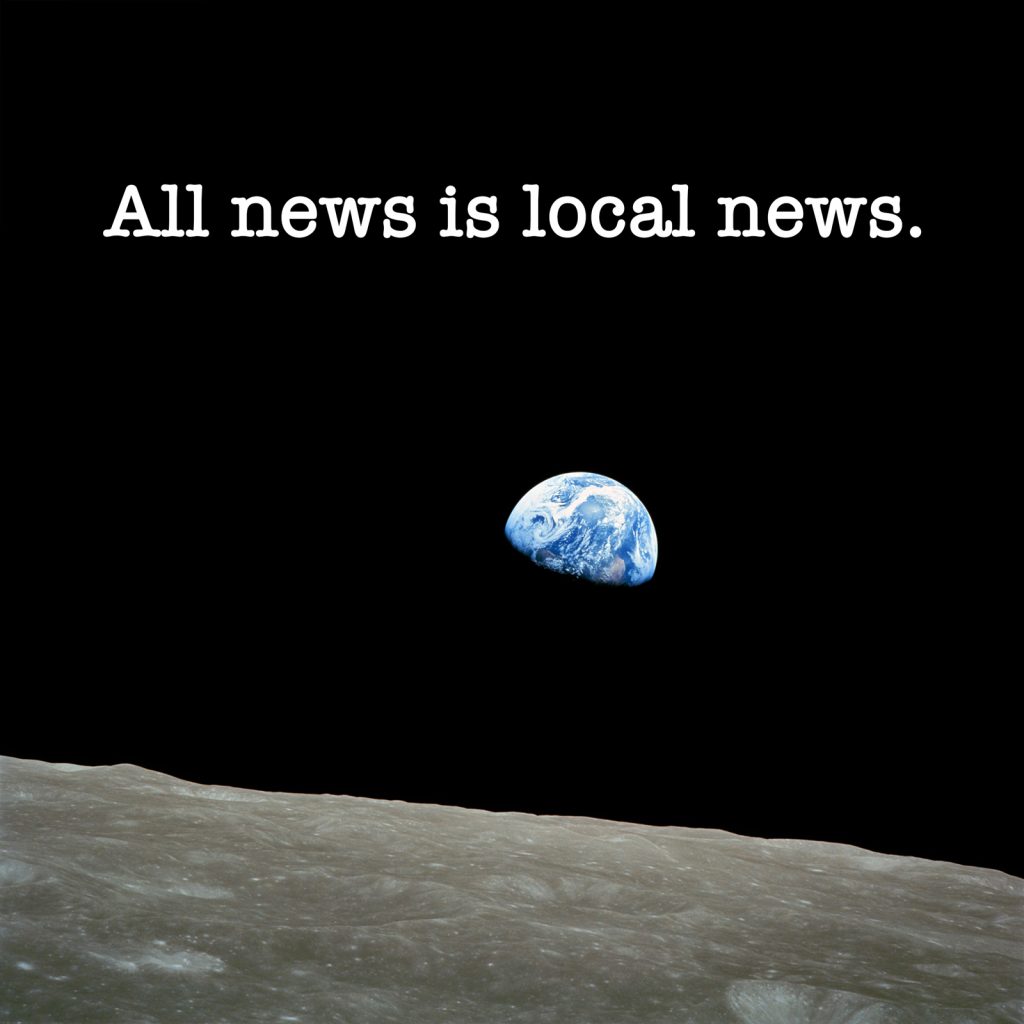
And this really does start at home – with the journalism available to you that represents your community. Your local paper. Your local radio station. Hell, even local facething groups and blogs count as local media – and creating quality journalism at the local level takes the support of the community.

That’s why I also support my local public radio stations (plural). They are doing boots-on-the-ground reporting on local and state issues every day, and they deserve my support for that, as I listen to them every damn day to know what’s happening int he world.

PLEASE HELP THE EUGENE WEEKLY GET BACK ON THEIR FEET

You may have noticed that I’m asking for your support for the Eugene Weekly. Click the link for the full story; the short version is just before Christmas the publisher discovered they had been embezzled and had to lay folks off.

The Eugene Weekly is an “alt” weekly – it’s not the biggest paper sold in town, but, given that the biggest paper in town is published elsewhere, it’s literally the only paper made in town. Now, Eugene is not my town – it’s south of here about an hour, but it’s a close enough community that I enjoy the connection offered by the weekly (it’s also my connection when I’m Jonesin’ for a crossword…)

During the pandemic, the paper kept going…thinner, but still going. It has provided an alternative view, of the area; it has provided opportunities for J-school students to do real-world reporting; it has garnered awards and accolades. And its letters are a trip and three-quarters most of the weeks.

Having an outlet for local journalism such as the Weekly makes a city more livable. To have someone gut it in such a cruel and petty manner is even worse than the ways hedge fund board rooms have been gutting newspapers for the past few decades. I mean, yes, the latter is a long, slow, and lingering death of some of the finest newsrooms in the country; but what happened to the Weekly was just a mean, ugly sucker punch below the belt.

At the same time, though, it was kind of a wake-up call.

Once the Weekly was off the street, and folks heard why, the floodgate opened in ways one might not have though imaginable. It’s been described like the scene from It’s A Wonderful Life when the town comes together to bail out the Bailey’s – tens of thousand of dollars (and, yes, you know I gave!) have flowed into the Weekly to make them whole again. The once-great Register Guard has shriveled over the year to a hollow shell of itself, run from the Statesman Journal up in Salem. Over all those years of troubles, the community did not stand up and make its voice heard about the need for the paper.

Faced with the dastardly loss of the Weekly, the community appears to be speaking.

PLEASE HELP THE EUGENE WEEKLY GET BACK ON THEIR FEET

If you can help the Weekly, please do. But if you are somewhere else, what’s your “Weekly”? What have you done for them, lately?

As we enter a year of conflict and disinformation all rolled together with the goo that is politics, it is more important than ever to have access to quality information, if one is to know what’s happening in their world.

We need our Weekly. Wherever we are.


NYTimes: https://newsletter.eugeneweekly.com/l/ISk0ERZ5tqVlPv5g01THSA/4fpgoc763VtQ2Yo763bQhp94Ww/TteTjhu4pzR5O7Jjieiy9A

CBS: https://www.cbsnews.com/news/oregon-newspaper-eugene-weekly-lays-off-entire-staff-employee-embezzled-funds/

© 2026 Blurg.

Theme by Anders NorenUp ↑